About
A guardian of the caravan roads.
Arsu was a guardian of travellers on the caravan roads that crossed this land, carved on stone at Palmyra nearly two thousand years ago. We borrow the name as heritage, the way a shipping line borrows the name of Hermes.
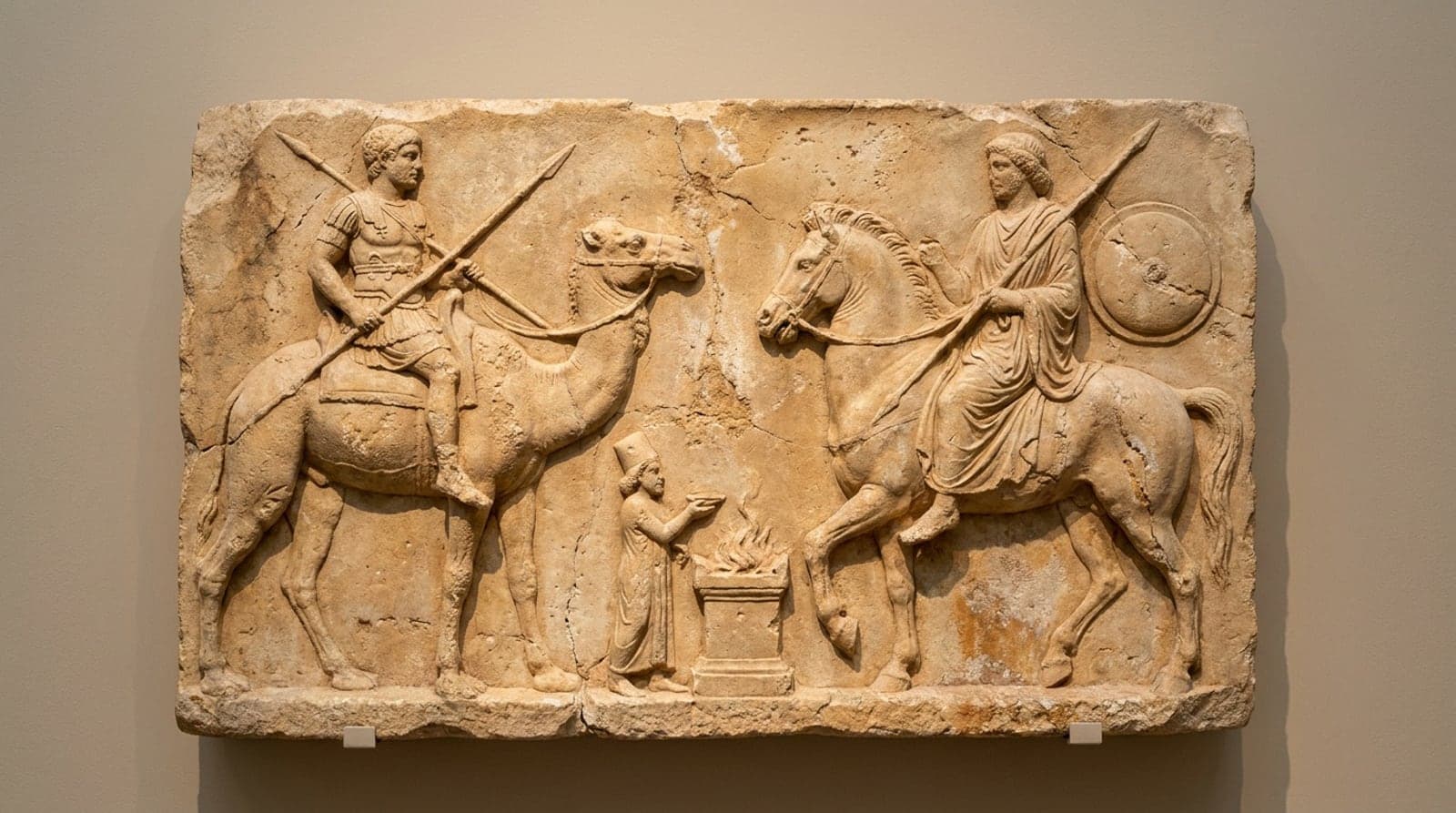
Illustration, not a photograph. Illustration, not a photograph. Drawn from the description of the paired Arsu and Azizos relief dated by inscription to 113 CE, National Museum of Aleppo. Arsu rides the camel in armour; his twin Azizos rides the horse in ordinary clothes; a priest makes an offering at the altar between them.
Who Arsu was
1st century BCE to 3rd century CE, Palmyra and Dura-Europos.
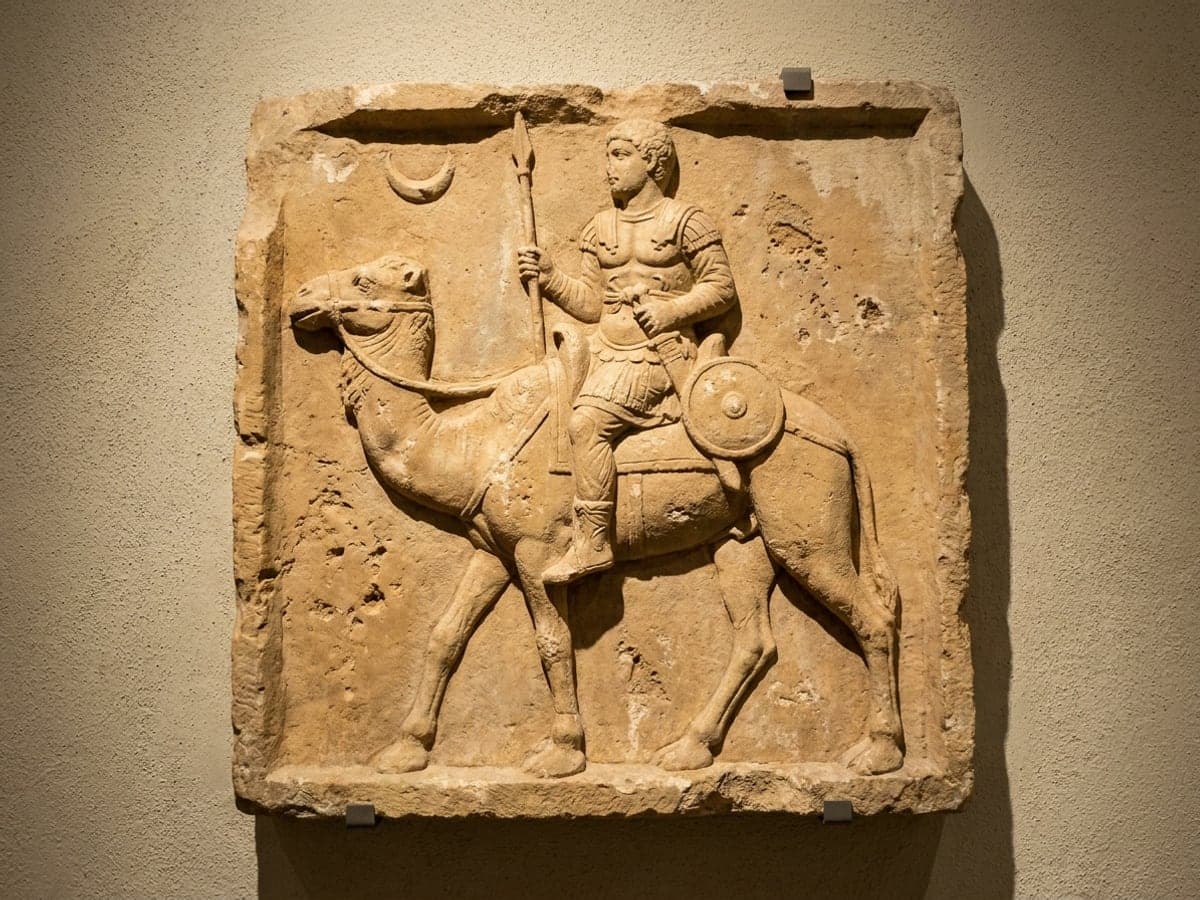
Illustration. Illustration, not a photograph. Drawn from the description of the Dura-Europos relief of Arsu the camel-rider (Yale University Art Gallery, YFE 1935.44, c. 100-200 CE).
Arsu belonged to Palmyra, the caravan city that linked the Roman Mediterranean to Mesopotamia and Arabia. He is attested from roughly the 1st century BCE to the 3rd century CE, and his best-documented role is a simple one: he protected caravans and the people travelling with them.
On the reliefs he rides a camel, in Roman-style armour with a spear and a small round shield. A pair of them, now in the museums of Aleppo and Damascus and dated by inscription to 113 CE, show him beside his twin Azizos, who rides a horse in ordinary clothes. A dedication calls them "the good gods who reward". Another relief, from Dura-Europos on the Euphrates and now at Yale, is inscribed to "Arsu the camel-rider".
Scholars since Rostovtzeff in 1932 have read the two brothers as the evening and the morning star — the two lights that lead caravans across the desert. That reading is widely repeated and worth knowing, but it is an interpretation rather than something the Palmyrenes wrote down, and the iconography is not perfectly consistent across every relief.
A temple to Arsu stood at Palmyra. Excavators there recovered a jar holding 125 tesserae — small clay tokens that worked as entry passes to a sacred banquet — one of the few complete sets ever found from a single occasion. A token that gets you in, kept by someone who travelled for a living: a reasonable thing for a travel company to be named after.
The cult itself ended a very long time ago, along with the caravan economy that supported it, after Palmyra’s defeat by Rome in 272–273 CE. The name is used here as history, and nothing more than that.
On using the name
Arsu is an archaeological subject, not a religious one. The cult ended with Palmyra’s caravan economy after the city’s defeat by Rome in 272–273 CE — more than seventeen centuries ago — and the related North Arabian cult of Ruḍaw is understood by specialists to have died out before the rise of Islam.
The name is used here the way a shipping line uses Hermes or a sportswear company uses Nike: as a piece of shared heritage from the place the company would be from. Nothing on this site invokes, revives, venerates or endorses anything, and nothing here is intended as a statement about any living faith.
Syria’s heritage is layered — Aramean, Roman, Byzantine, Umayyad, Ayyubid, Mamluk, Ottoman, and modern — and every layer belongs to the people who live there now, whatever they believe. If any of this reads wrong to a Syrian reader, that is worth telling us; getting it right matters more than the name does.

Where this comes from
The account above is drawn from museum catalogues and published scholarship rather than from memory. The star-pairing of Arsu and Azizos in particular is a long-standing scholarly reading, not something the Palmyrenes recorded, and it is presented that way.