
The Roman theatre
المسرح الرومانيAround 15,000 seats of black basalt, with the stage building still standing to its full height.
Restored 1947–1970; September 2026 reporting describes restoration as complete. On the Danger List.
Demo site — Arsu Tours is not a real company. Nothing here can be booked. What this is
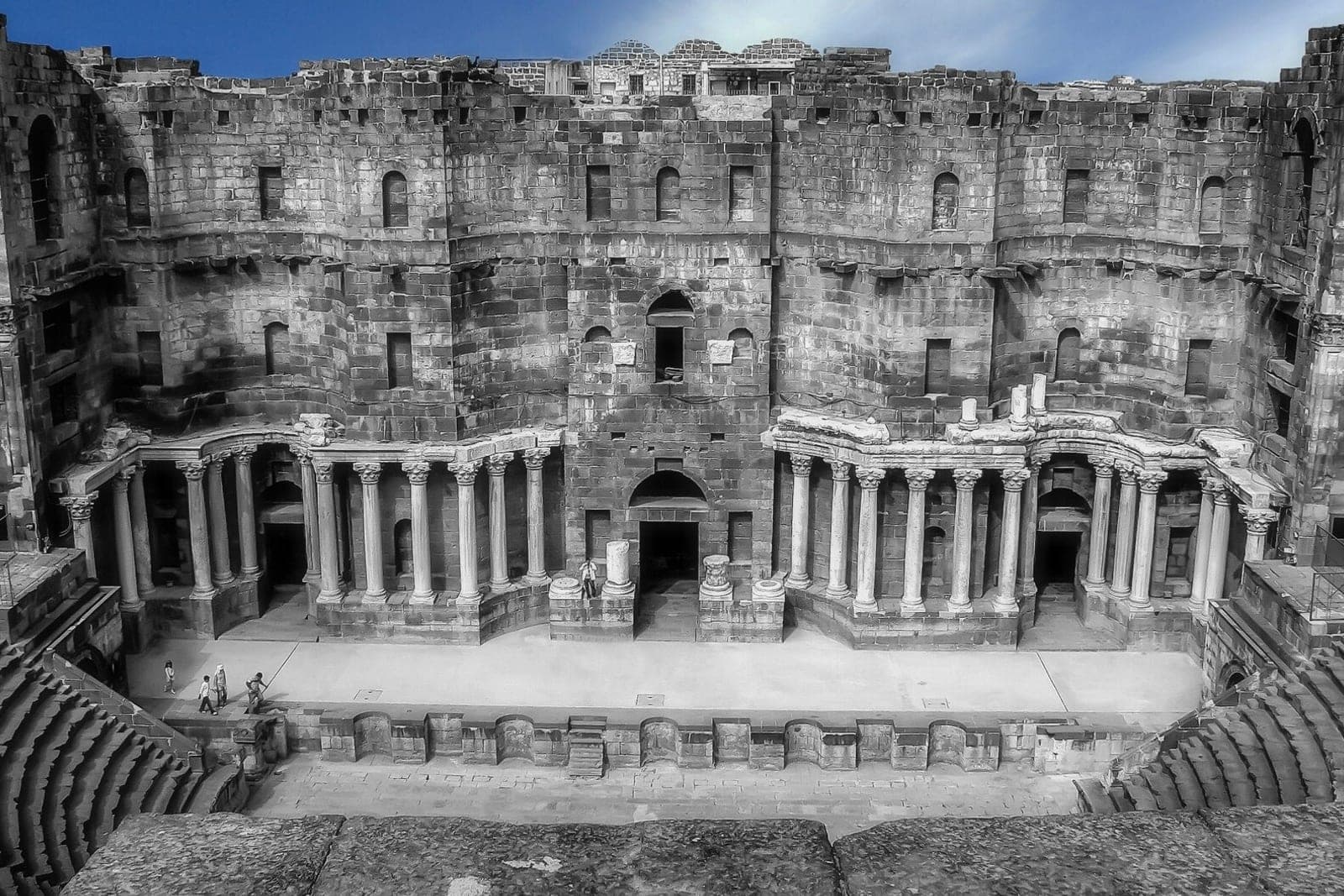
The Roman theatre at Bosra, built of black basalt, seen from the seating. Photo by Lubomir Mihalik via Wikimedia Commons · CC BY 3.0
A 2nd-century Roman theatre in black basalt, wrapped inside an Ayyubid citadel that is the reason it survived. The acoustics are as good as you have been told.
Bosra was the Nabataean capital before Rome annexed it, then capital of the Roman province of Arabia. The theatre seats around 15,000 and is built entirely of the local volcanic stone, which is why the whole town reads dark.
The citadel that encloses the theatre was built around it by the Ayyubids as a fortress. That accident of reuse is why this theatre survived when others did not.
The theatre was restored between 1947 and 1970, and September 2026 reporting describes restoration as complete. But Bosra is in Daraa Governorate, where the 2011 uprising began. The town was a battleground, held by opposition forces from March 2015 until July 2018, and UNESCO documented specific war damage in December 2015. It remains on the Danger List.
Condition notes are given for each site, including where something was destroyed or is closed. They are the point of this page.
Around 15,000 seats of black basalt, with the stage building still standing to its full height.
Restored 1947–1970; September 2026 reporting describes restoration as complete. On the Danger List.
The fortress built around the theatre, so that you enter the Roman building through a medieval one.
War damage documented by UNESCO in December 2015; restoration reported since.
One of the oldest surviving mosques in the region, plain and square in the same black stone.
A 2014 shell strike opened the roof and damaged the upper level. Interior and facade have since been worked on.
A small basalt mosque in the town, among the ordinary streets rather than inside the site.
Standing. Detailed post-2011 condition not found in the sources consulted.
A battleground town in the governorate where the uprising began. Damage is documented and specific; restoration is real and partial.
Reopened to tourism on a small scale — more than 50 foreign visitors reported in a dated September 2026 account.
The stone itself. Theatre, citadel, mosques and houses all cut from the same black basalt.