
Serjilla
سرجيلةThe most complete of them: a bath house, a meeting hall, villas and presses in a shallow bowl of rock.
Largely intact. A guesthouse in the western part of the site was lost to an airstrike during the war.
Demo site — Arsu Tours is not a real company. Nothing here can be booked. What this is
Byzantine farming villages, left a millennium ago, across the limestone hills
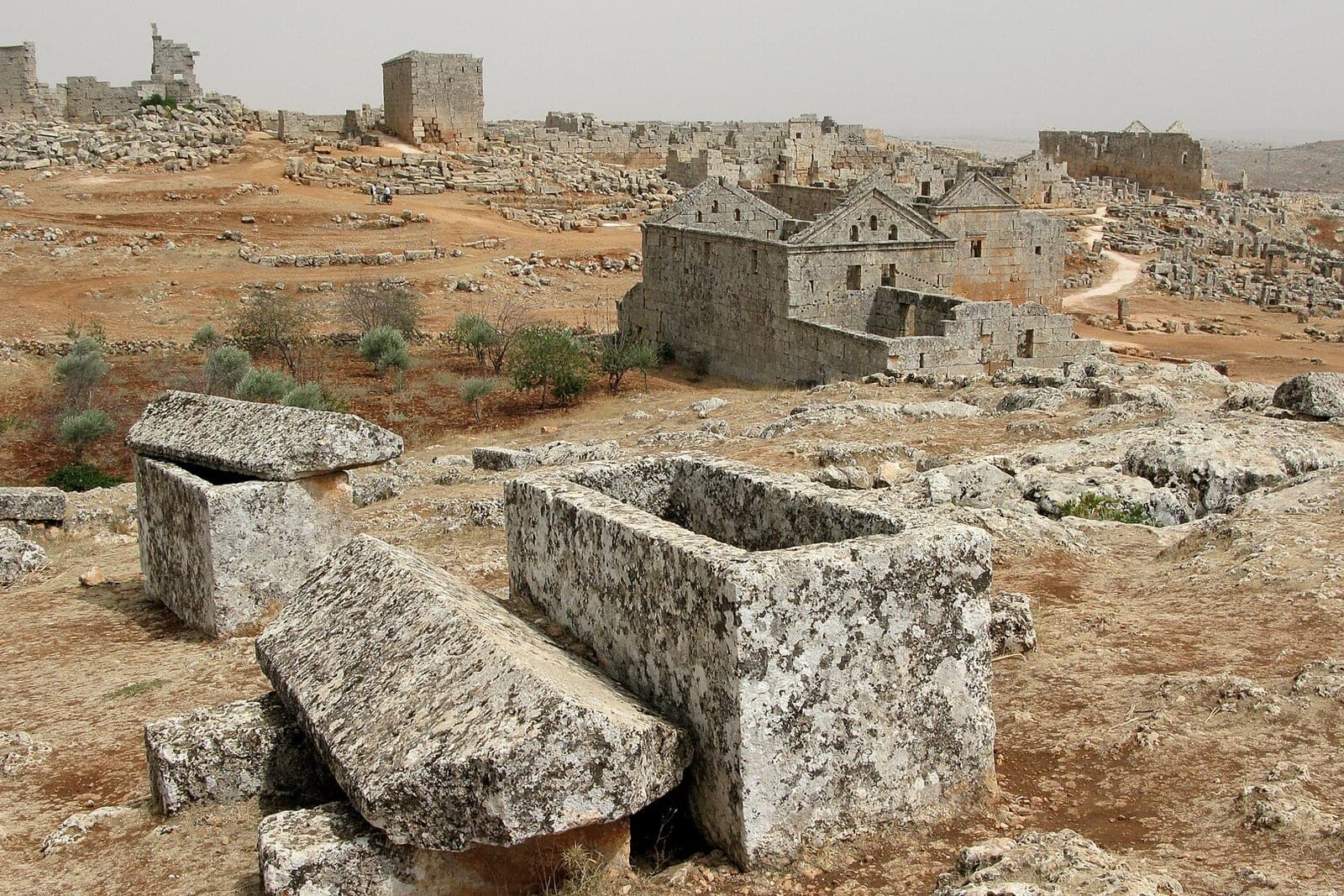
The limestone ruins of Serjilla, one of the Dead Cities of northern Syria. Photo by Vyacheslav Argenberg via Wikimedia Commons · CC BY 4.0
Forty-odd stone villages — houses, olive presses, bath houses, churches — abandoned between the 8th and 10th centuries and never built over. Serjilla is the one to walk.
UNESCO inscribed these in 2011 as the Ancient Villages of Northern Syria, and added them to the Danger List in 2013. Those are two different events two years apart, which popular sources routinely merge.
How many villages there are depends on what you count. Thirty-six are formally inscribed across eight parks; UNESCO itself says "around 40"; the wider limestone massif holds somewhere between 700 and 800 archaeological sites. The site gives you the range rather than a false precision.
They are not ruins in the sense of a collapsed city. They are ordinary villages — farmhouses with their door frames still square — that emptied out as trade routes shifted, and were left standing.
Condition notes are given for each site, including where something was destroyed or is closed. They are the point of this page.
The most complete of them: a bath house, a meeting hall, villas and presses in a shallow bowl of rock.
Largely intact. A guesthouse in the western part of the site was lost to an airstrike during the war.
Built around the pillar on which Simeon lived for decades — for a time the largest church in the world.
Part of the pillar remnant and surrounding ruins were damaged in an airstrike in May 2016.
The largest of the villages, with pyramid-roofed tombs among the olive terraces.
Dispersed and partly overgrown.
A 5th-century basilica whose twin-towered facade is often said to have influenced Romanesque church fronts.
Facade and much of the structure still stand. The claim that it inspired Notre-Dame traces to a single early-20th-century opinion, not consensus — treat it as a story about the building, not a fact.
Unusual among these sites: some of the ancient houses have been lived in again.
Partly reoccupied.
Damage is documented at specific sites rather than uniform across the region — Saint Simeon in May 2016, western Serjilla separately. Displacement also brought people to shelter in some of the ruins.
Country-wide advisories apply; there is no site-specific carve-out. Idlib’s situation has changed considerably since December 2024 and should be checked fresh.
Olive oil, then and now — these villages were built on it, and the presses are still standing in the ruins.