
Hall of the Knights
قاعة الفرسانThe vaulted Gothic hall at the heart of the inner ward, with its carved loggia.
War-damaged 2012–2013 — staircase and carved elements. Restoration reported by DGAM and UNESCO.
Demo site — Arsu Tours is not a real company. Nothing here can be booked. What this is
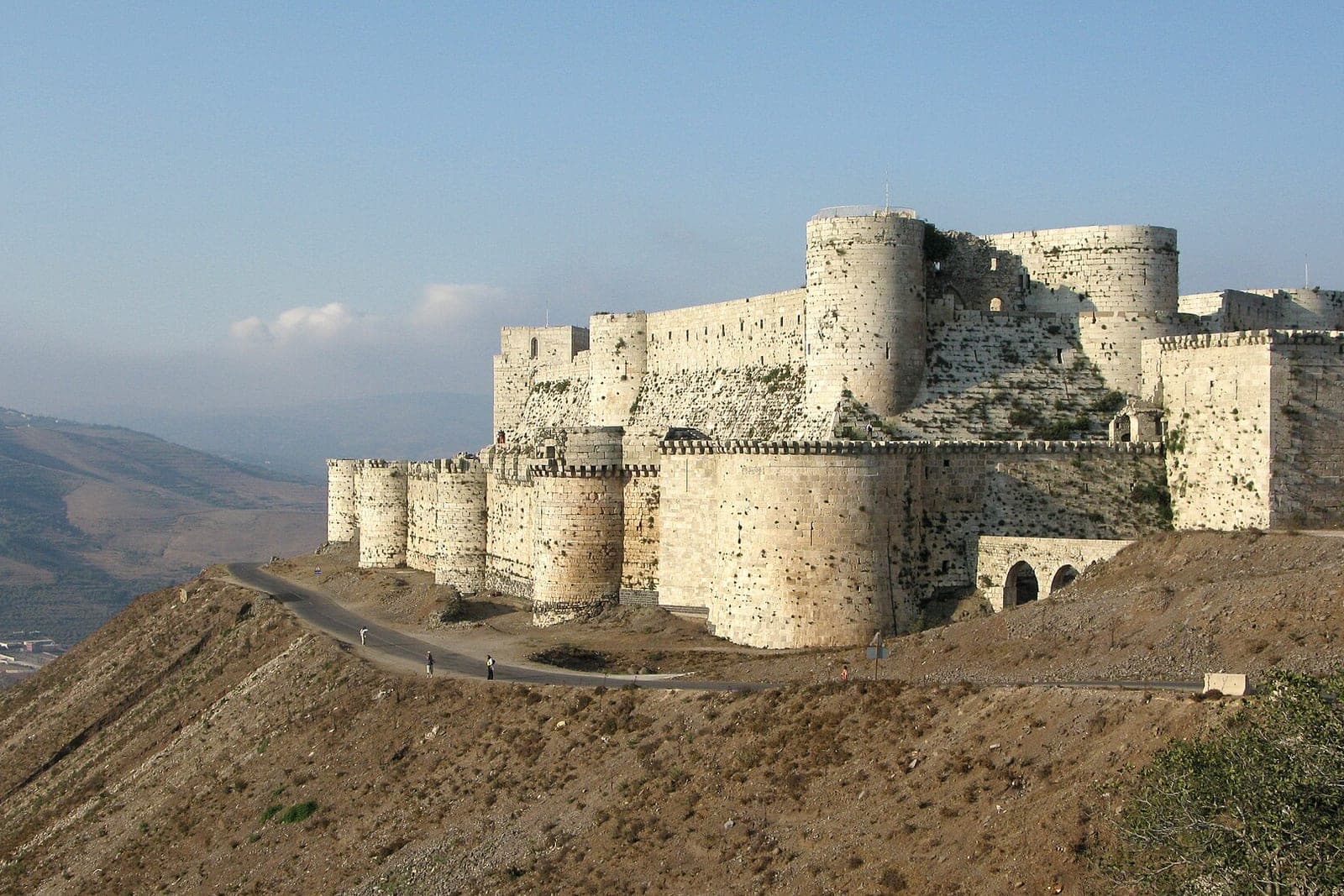
The concentric crusader castle of Krak des Chevaliers on its ridge. Photo by Vyacheslav Argenberg via Wikimedia Commons · CC BY 4.0
Most travellers come for Krak des Chevaliers, an hour west — one of the best-preserved crusader castles anywhere, and damaged in this war like everything else. We add the city itself, and the families who chose to come back to it.
Krak des Chevaliers sits on a spur above the Homs Gap, the corridor that links the coast to the interior. Whoever held it controlled the road. The Knights Hospitaller held it from 1142 until 1271.
It was shelled by government forces in August 2012, which damaged the chapel, and hit again by shelling and a July 2013 airstrike that damaged towers, the carved loggia and the staircase of the Hall of the Knights, while the castle was held by opposition forces. Restoration has been under way since, including a Syrian–Hungarian mission that stabilised frescoes in the former chapel.
The countryside below is Wadi al-Nasara, the Valley of the Christians — a long-mixed region of Christian and Muslim mountain villages.
Condition notes are given for each site, including where something was destroyed or is closed. They are the point of this page.
The vaulted Gothic hall at the heart of the inner ward, with its carved loggia.
War-damaged 2012–2013 — staircase and carved elements. Restoration reported by DGAM and UNESCO.
The concentric defence that made the castle famously difficult to take by force rather than by trickery.
Cracked by the 2012–2013 shelling and airstrike; the wall between the Commander’s and Knights’ Towers took the worst of it.
A crusader chapel later used as a mosque — the two uses legible in the same room.
Damaged 2012–2013; frescoes stabilised by a Syrian–Hungarian conservation mission.
The outer ring and the water-filled ditch between the two walls.
Largely intact, with restored sections.
Direct war damage in 2012 and 2013, followed by an ongoing restoration programme. "Best preserved" is still fair; "undamaged" is not.
Reopened to visitors, with tour operators running trips since spring 2025. Opening hours and any permit requirements should be confirmed directly.
Wadi al-Nasara, the valley below the castle, and the mountain villages spread through it.